Virtual Assistant vs AI: Why Skilled VAs Got More Valuable After the AI Boom
When ChatGPT launched, a lot of smart people predicted the end of virtual assistant work. The logic seemed sound. If AI could draft emails, summarize documents, schedule meetings, and research vendors, why keep paying someone hourly to do the same tasks?
Three years later, the opposite happened. Demand for skilled VAs climbed. Rates for the best ones went up. According to Wishup's 2026 Virtual Assistant Industry Report, 88% of companies now use AI in at least one business function, but only 39% see real bottom-line impact from it. That gap, between using AI and actually getting results from it, is where skilled virtual assistants moved in and became essential.
This post covers why the virtual assistant vs AI question turned into a false choice, what skilled VAs actually do inside an AI-enabled business, and how to hire for the shift.
What the virtual assistant vs AI debate got wrong
The original framing treated the two as interchangeable. You have a task. Either a person handles it or a model handles it. Pick one.
That is not how either one works inside a running business.
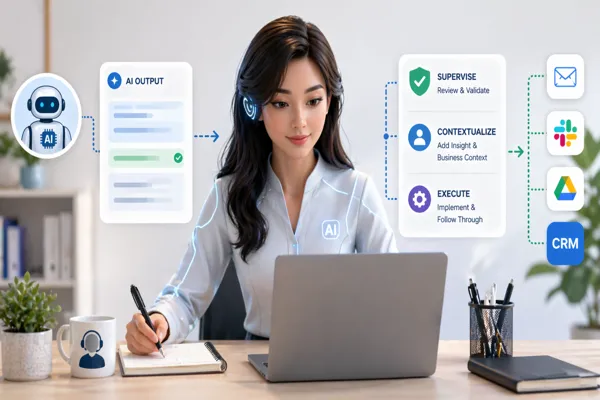
AI produces output. Someone still has to read that output, decide if it is correct, fix what is not, and move it into the systems the business actually uses. The judgment and follow-through layer is where most of the real work lives, and it is exactly where virtual assistants became indispensable.
Real example: An AI tool drafts 20 client emails in two minutes. Without a VA reviewing them, 3 ship with wrong names, 1 repeats an offer the client already declined, and 1 uses a tone the client finds pushy. The speed gain disappears in damage control. With a VA reviewing, those 20 emails ship clean in 25 minutes instead of 8 hours, and the brand stays intact.
The three roles VAs now play in AI-driven businesses
The tasks businesses hand to VAs changed shape. The volume did not drop. A few patterns show up across almost every role.
Supervision
AI drafts a proposal that sounds professional but gets a pricing tier wrong. AI writes a LinkedIn post that misreads the tone of the company. AI generates a spreadsheet formula that works for nine rows and breaks on the tenth. Without someone catching those errors before they ship, the cost of AI output is a liability rather than an asset.
Stanford's AI Index Report has repeatedly documented that even the most advanced models still produce factual errors at meaningful rates, depending on the domain and complexity of the query. In a business context, those error rates multiply across every email, post, report, and document the model touches. VAs who can read output critically and push back are the first line of defense.
Contextualization
Models do not know your client's preferences, your internal naming conventions, which vendors you have fired, or why last year's campaign flopped. A VA who has worked with a business for six months can read an AI-generated plan and flag that the recommended tool was rejected in Q2 for security reasons. The model cannot do that. It will recommend the same tool again tomorrow.
This is where the AI and virtual assistants pairing produces real leverage. AI brings speed and pattern recognition. The VA brings institutional memory, relationship history, and the informed pushback that prevents obvious mistakes.
Execution
This is the part the AI replacement crowd underestimated most. Drafting a message is a small piece of actually sending one. Somebody has to log into the CRM, find the right contact, paste the message, attach the right file, verify the links, hit send, log the interaction, and update the status.
AI does not do hands-on work across multiple platforms. A VA does. And when the workflow breaks, because an integration fails or a tool updates its UI, the VA adapts. The model does not.
Does AI replace virtual assistants for any tasks?
Yes, for some narrow ones. The pure generation work, such as drafting rough copy, summarizing transcripts, and producing first-pass research, got significantly faster. A VA who used to spend three hours writing a newsletter now spends forty-five minutes editing one the model produced. Time-per-task dropped.
What did not drop was the number of tasks per VA. Businesses that freed up hours filled them immediately with work they previously could not afford to delegate. The same VA who used to just handle email now runs social media, manages inbound leads, keeps the calendar, and audits AI output across five different workflows. The role expanded.
What tasks fully automated away?
Narrow ones. Transcription of clear audio. Simple data entry from structured forms. First-draft FAQ copy. Basic chatbot-level customer service for predictable questions.
Everything else either shifted shape or stayed human. When the work "shifted shape," the VA did not disappear. The VA picked up AI tools and became faster.
What a high-performing AI-assisted VA workflow looks like
Consider a typical outbound sales workflow. A business wants to send 40 personalized follow-ups a week to warm prospects.
Before AI, a VA would research each prospect, draft each email from scratch, and send them. Roughly 15 minutes per email. That works out to 10 hours a week.
With AI in the mix, the VA pulls company data, feeds it into a model with a prompt reflecting the brand voice, reviews the drafts, rewrites the 8 or 9 that miss the mark, verifies every claim against the research, sends them, and logs the outcomes. Now it is closer to 5 minutes per email. Capacity doubled.
Same workflow. Different economics.
The VA did not become optional. The VA became the reason the workflow holds up. Remove them and the model sends confidently wrong information to 40 prospects a week. That creates a brand problem with a 40-prospect blast radius, not a productivity gain.
This is the model Steun Outsourcing built the business around. Our Operational Support Solutions pair skilled virtual professionals with structured AI-assisted workflows and SOP-driven execution. The goal is not to replace human judgment with automation. The goal is to give judgment better tools.
Schedule a free discovery call to see how an AI-assisted VA setup could work in your business.
The new economics of AI and virtual assistants
The cost calculation shifted. Hourly rate matters less. Output quality per hour matters more.
A $12/hour VA who needs constant supervision costs more than a $25/hour VA who owns their work, because the supervision hours come from someone whose time is more expensive, usually the founder. Pair a low-skill VA with AI tools and you do not get better output. You get faster production of errors.
Why cheap unsupervised VAs cost more than they save
The math is straightforward. If a VA produces work that needs 25% rework by a founder billing at $200 an hour, the real cost of that VA is not their rate. The real cost is their rate plus the founder's hourly rate multiplied by rework time. Run that calculation for a full month and the "cheap" VA often costs two to three times what they charge on the invoice.
Skilled AI-literate VAs flip the math. They absorb more work rather than less. They reduce founder involvement rather than adding to it. That is why Steun built Managed VA Solutions around a supervision layer. Someone on our side owns QA so the founder never becomes the bottleneck.
What to look for when hiring a VA in an AI-first environment
The baseline changed. A VA who can only execute step-by-step instructions is worth less than one who can take a messy goal, prompt a model effectively, review the output, adapt it, and finish the job.
Three skills separate VAs that clients pay premium rates for.
They know when to use AI and when not to. Low-stakes, high-volume tasks get the AI treatment. Client-facing, reputation-sensitive, or judgment-heavy tasks do not.
They prompt well. Not in a technical sense. They have done the work long enough to know what a good brief looks like, and they translate that into inputs the model can act on.
They read output with a critical eye. They notice when a tone is off, when a fact looks suspicious, when a list is padded with filler. They catch it before anyone else sees it.
How do you test for these skills in an interview?
Give the candidate a short AI-generated document with three errors embedded in it. Ask them to find the problems and explain how they would fix the workflow that produced them.
A weak candidate either misses the errors or fixes them without questioning the process. A strong candidate flags the errors, explains why they happened, and suggests a prompt change or QA step to prevent them next time. That is the thinking you want on your team.
The World Economic Forum's Future of Jobs Report 2025 identified analytical thinking, resilience, and AI literacy among the top skills employers will compete for through 2030. Those skills map directly onto what high-value VAs now deliver.
Why AI made human supervision a core deliverable
For most businesses, AI tools without oversight are a risk rather than an asset. The 88%/39% gap from the Wishup report tells the whole story. Most companies plugged in AI and expected results. Most are still waiting.
The ones actually seeing returns share a pattern. They built supervision into the workflow. They assigned ownership of AI output to a human. They documented what "good" looks like so the supervisor has something to measure against.
This is why the Steun model includes a management layer by default. We supervise so the founder does not have to. The alternative, asking a founder to run QA on a team of VAs who are in turn running QA on AI output, is a recipe for burnout and quality drift.
Industries where the AI and virtual assistants shift hit hardest
Not every business felt the change equally. A few where it landed with the most weight:
Digital marketing agencies
Content production, outbound research, reporting, and social media scheduling all got faster with AI. They also got more error-prone. Agencies that leaned into AI without a QA layer started losing clients over brand voice drift and factual mistakes. The ones that built a VA layer between AI and deliverables held their margins and grew.
Medical and aesthetic clinics
Patient communication, appointment coordination, and review responses can all be partially AI-assisted. None of it can ship without a human verifying clinical details and HIPAA-sensitive context. VAs who understand clinic workflows became critical for any practice trying to scale.
E-commerce brands
Product description generation, customer service triage, and inventory reporting are heavily automatable. But a VA still has to catch when the AI confidently invents a product spec or mishandles a return request. Brands that tried pure automation saw refund rates and complaint volumes climb.
Consultants and coaches
Proposal drafting, client note summaries, and email outreach all speed up with AI. The quality bar for personal-brand work is high. One tone-deaf AI-drafted email lands in an inbox and the client relationship takes damage. A VA edits before the message ships.
Recruitment firms
Candidate sourcing, outreach at volume, and initial screening are all AI-accelerated workflows now. A VA reads the results, removes false positives, and handles the judgment calls about fit. Without that layer, firms burn candidate goodwill with poorly targeted outreach.
Frequently asked questions
Will AI eventually replace virtual assistants entirely?
Not in any realistic near-term horizon. What AI does well is pattern-based generation and routine automation. What AI does poorly is judgment, contextual awareness, and cross-system execution. Those three things are the core of most VA work. As models improve, VAs will handle more AI output per hour, but the VA role itself is not going away.
How is AI-assisted outsourcing different from traditional outsourcing?
Traditional outsourcing adds labor hours to handle tasks. AI-assisted outsourcing adds structured execution capacity, which means people, processes, and AI working together under supervision. Tasks get done faster and more consistently, with fewer bottlenecks. The Steun model is built on this distinction. Traditional outsourcing gives you a person. AI-assisted outsourcing gives you a system.
Should I use AI or a VA for a given task?
Rule of thumb: if the task is high-volume, repetitive, and tolerant of some error, AI first. If the task is client-facing, brand-sensitive, or requires judgment, VA first. For most tasks, the answer is both. AI drafts. VA finishes and ships.
What does "AI-literate" actually mean for a VA?
It means the VA can identify which tools fit which tasks, write clear prompts, evaluate output for quality, and combine AI-generated content with manual execution steps to complete the full workflow. It does not mean the VA is a programmer or a prompt engineer. It means they know how to use AI the same way a good assistant knows how to use a CRM.
Can you manage VAs that already work inside my business?
Yes. That is what Managed VA Solutions was built for. You keep the brand, pricing, and client relationships. We handle recruitment, training, daily supervision, and QA. This is especially useful for consultants expanding into recurring service models who need operational depth without building a management layer from scratch.
The Bottom Line
AI did not eliminate virtual assistant work. The shape of the work changed. The routine parts got automated. The judgment, supervision, and execution parts got more important.
VAs who adapted to that shift are running bigger scopes than they were three years ago, and they are getting paid accordingly. Businesses still framing virtual assistant vs AI as an either-or choice are usually the ones getting neither to work well. The ones winning have both, with the VA running point.
The $19.5 billion global VA market is not growing despite AI. It is growing because of AI. AI made business operations faster and more error-prone at the same time, and that combination demands human oversight. The businesses that invest in the oversight layer pull ahead of the ones that do not.
Ready to build a support structure that pairs human judgment with AI-assisted execution?Book a free discovery call to see how Steun Outsourcing's staffing, operational support, and managed VA solutions can fit your business.